Appearance
Time Complexity (TC)
TC is not about the time taken to complete the task. It's a relationship between the input size and time - to measure how time will grow as the input grows.
TC ≠ Time Taken
In general we are not concerned about the small input size as anyways it will be computed with minor time variation. But, when input grows it will matter how efficient algorithm is.
10 users using a website vs. 1 million users using it. We care about supporting 1M users, as that can reveal the worst-case performance.Time complexity in increasing cost order:
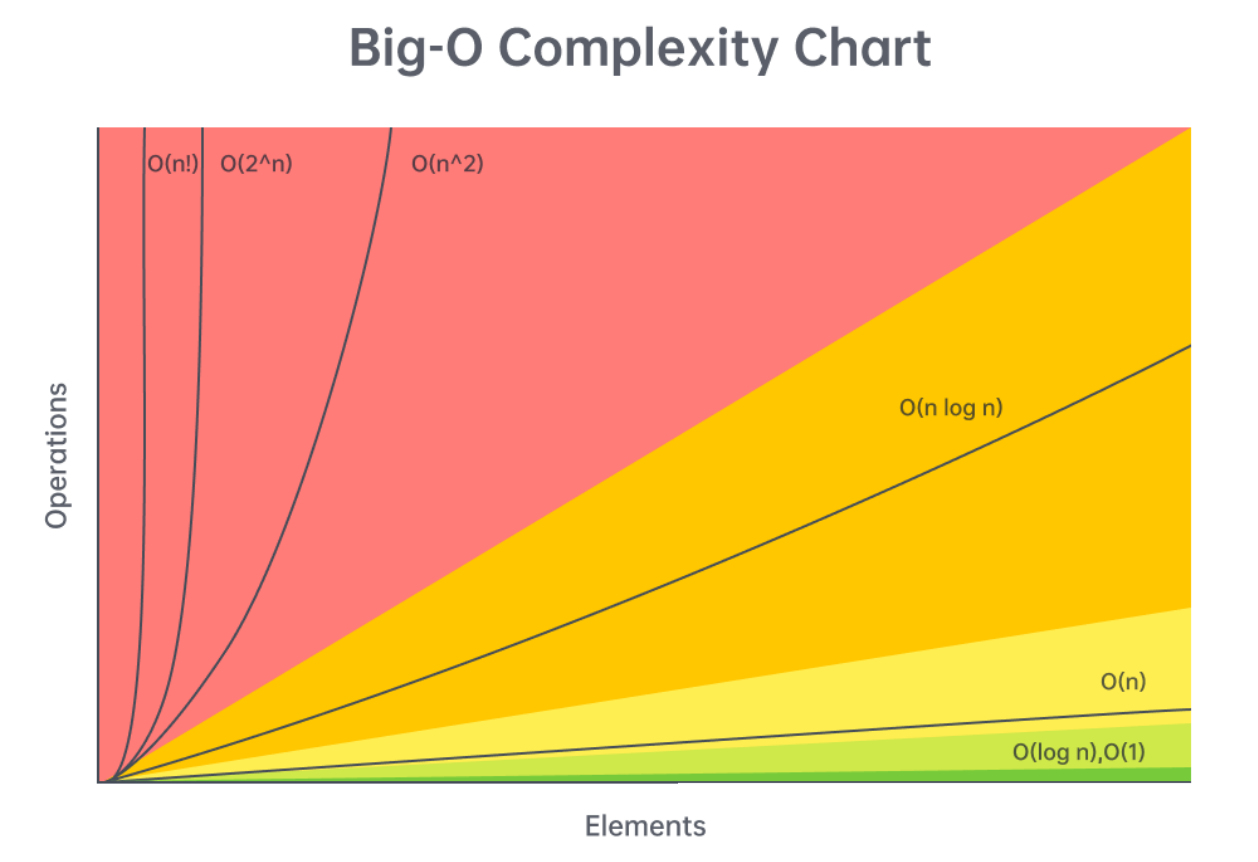
O(1) < O(log n) < O(n) < O(n log n) < O(n^2) < O(2^n) < O(n!)How to calculate Time Complexity?
Using following rules we can calculate the time complexity:
- Ignore all constants - because we care about the relationship but not the actual time taken.
- Always ignore the less dominating terms.
- Always consider the worst case complexity.
Example: O(3n^3 + 2n^2 + 5n + 9)
Rule 1: Ignore all constants: O( 3 n^3 + 2 n^2 + 5 n + 9)
Rule 2: Ignore less dominating terms: O( n^3 + n^2 + n)
Rule 3: O(n^3)
Time Complexity Comparison
| Complexity | Notation | Description | Examples |
|---|---|---|---|
| Constant | O(1) | Complexity remains the same regardless of input size | Accessing an array by index, HashMap lookups |
| Logarithmic | O(log n) | Complexity grows logarithmically with input size | Binary search, finding an element in a balanced BST |
| Linear | O(n) | Complexity grows linearly with input size | Finding an element in an array, counting elements in a list |
| Linearithmic | O(n log n) | Complexity grows linearithmically with input size | Merging two sorted arrays, sorting an array with quicksort or mergesort |
| Quadratic | O(n^2) | Complexity grows quadratically with input size | Bubble sort, insertion sort, finding pairs in an array |
| Exponential | O(2^n) | Complexity grows exponentially with input size | Recursive Fibonacci, finding all subsets of a set |
| Factorial | O(n!) | Complexity grows factorially with input size | Brute-force solution for the traveling salesman problem |
Common examples
- Sorting: O(n log n)
- Array traversing: O(n)
- Nested loop: O(n^2)
- Nested loop of 2 different arrays: O(n*m)
- Binary Search: O(log n)
- Hashmap lookup: O(1)